Can Physiotherapy Help With This? From Vertigo to Pelvic Pain: 7 Evidence-Based Conditions It Can Treat
HOLISTIC PHYSIOTHERAPY & WELLNESS • MAY 2026 • NATIONAL PHYSIOTHERAPY MONTH
Written by Kim Deschamps, MPT, BKin, PYT, BDN — Founder & Physiotherapist, Holistic Physiotherapy & Wellness, Saskatoon
TL;DR
Physiotherapy treats more than injuries — including vertigo, pelvic floor issues, nerve pain, heel pain, headaches, and concussion
Feeling stiff all the time may be muscle guarding — a nervous system response, not just tight muscles
Numbness and tingling are often nerve-related and can be effectively treated with physiotherapy
Heel pain (especially that sharp first-step pain in the morning) is commonly plantar fasciitis — and physio can help
Fear of movement can slow recovery, but it’s something we can work through safely together
Pelvic floor issues like leaking or pain are common — but they’re not something you have to live with
Concussions aren’t just something to monitor for 24 hours — ongoing symptoms often involve the neck, balance, and nervous system, and physiotherapy plays a key role in recovery
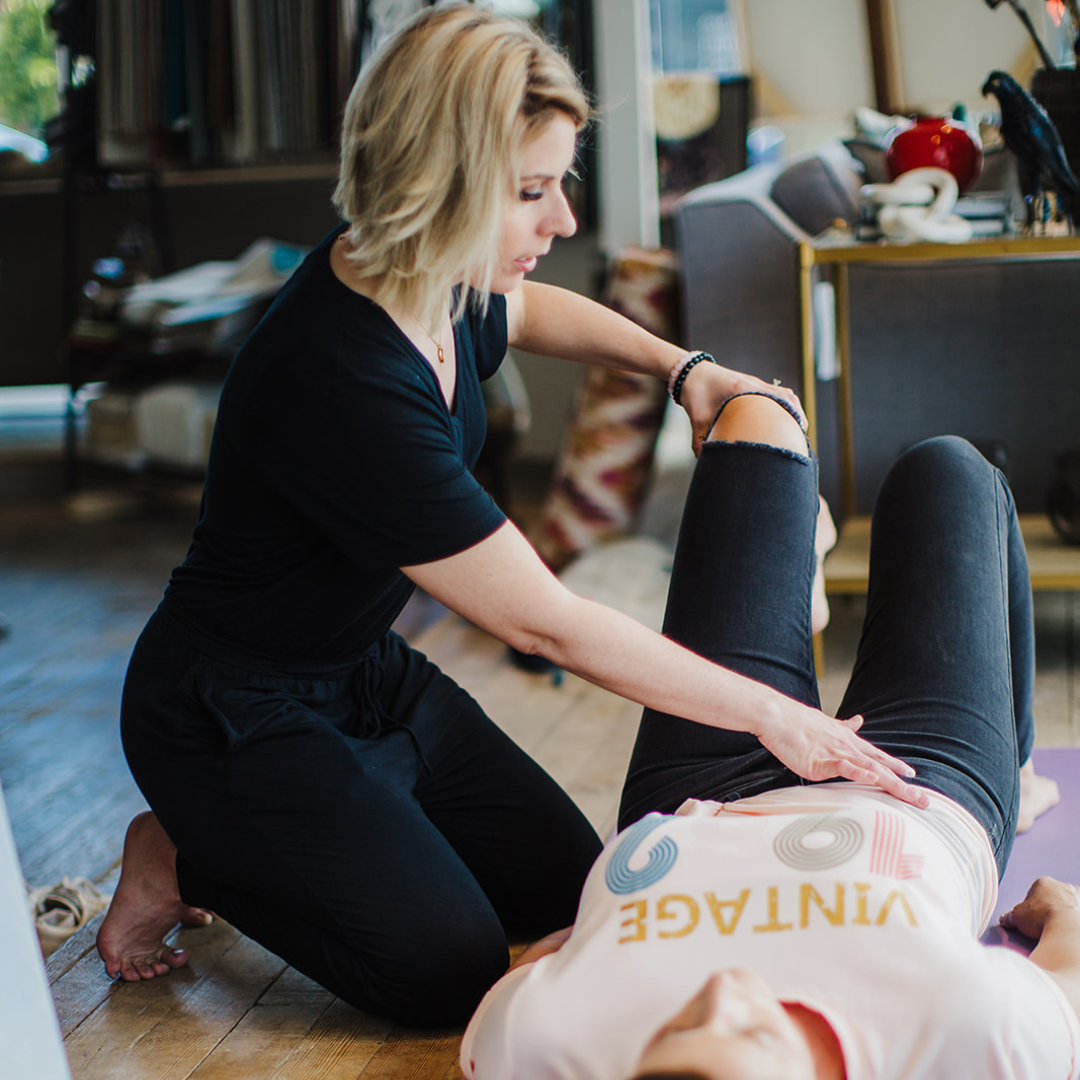
Most people think physiotherapy is only for injuries. And I want to change that.
Physiotherapy can also help with things like dizziness, pelvic health, headaches, nerve pain, heel pain, and that constant stiffness you feel every day.
If you’ve been wondering:
"Why do I feel stiff when I didn’t exercise?"
"Is this just part of aging?"
"Why am I getting numbness or tingling?"
"Why does my heel hurt when I get out of bed?"
"Is it normal to leak when I sneeze?"
There’s often more going on — and physiotherapy can help you understand it.
I’ve been practicing physiotherapy in Saskatoon for over a decade. I built Holistic Physiotherapy & Wellness because I kept seeing the same pattern: people were telling me they weren’t getting answers and that no one was looking at the whole picture. They’d been to appointments and felt they were being sent home without lasting solutions.
At Holistic Physiotherapy & Wellness, my team and I take a collaborative, holistic approach to figure out why something is happening — not just where it hurts. May is National Physiotherapy Month in Canada, and I want to use it to talk about the conditions that people can come to their physiotherapists first.
1. Feeling Stiff All the Time? It Might Not Be Tight Muscles.
Feeling stiff isn’t always about tight muscles.
Often, it’s something called muscle guarding — when your body stays in a protective, braced state after injury, stress, or repeated strain. Your nervous system is trying to protect you. But it doesn’t always know when to stop.
Over time, this chronic bracing can:
→ Limit your range of movement
→ Increase discomfort in the original area and create new pain patterns elsewhere
→ Make rest feel unproductive, because the tension is still there
I grew up watching people close to me live with recurring pain. They were going to appointments, doing what they were told — and still not getting better. I kept wondering what was missing. It’s a question that still drives the way I practice today.
Physiotherapy helps your body relearn:
→ What’s safe to do
→ How to move again without fear
→ How to release tension that no longer serves a purpose

A 2023 Canadian study of more than 2,800 people living with chronic low back pain found that kinesiophobia — fear of movement — was present in over 26% of participants, and pain catastrophizing in more than 55%. These aren’t character traits. They’re nervous system responses. And they’re very much within the scope of what we work on together.
2. Numbness or Tingling? Understanding Nerve Pain and Sciatica.
Numbness, tingling, or “pins and needles” are usually related to nerve irritation — not just muscle tightness.
This can come from:
→ Sciatica — irritation of the sciatic nerve running from the lower back into the leg
→ Disc irritation or herniation in the lumbar spine
→ Tight muscles or postural patterns that compress nerves over time
You might hear it called a “slipped disc” — but what’s really happening is that one of the discs in your lower back has become irritated and is putting pressure on a nearby nerve. You don’t need to live with the burning, shooting pain or the numbness that makes your leg feel foreign.
In Canada, chronic low back pain with associated sciatica affects a significant portion of the adult population — a 2023 Canadian study found that nearly 59% of people with chronic low back pain also reported sciatica symptoms. Physiotherapy and guided movement are evidence-informed, first-line approaches for these presentations, helping reduce nerve compression and restore function.
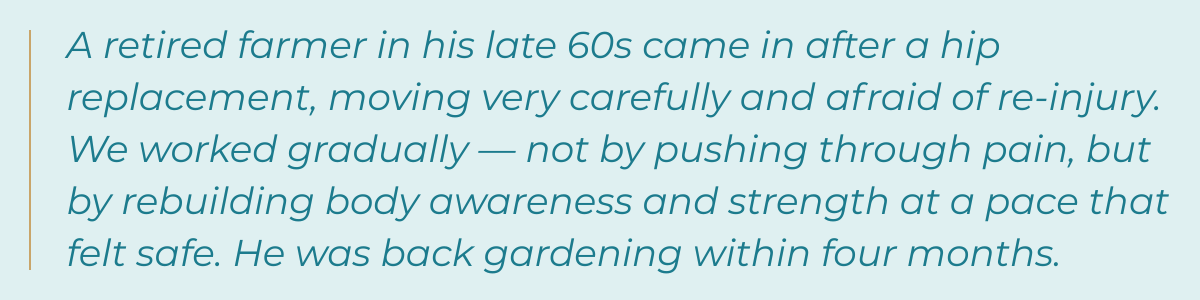
When I assess someone with nerve-related pain, I’m looking at your posture, how you move, how your muscles are activating, and how your nervous system is responding. I’m trying to find the root cause of the irritation — not just manage the symptom.
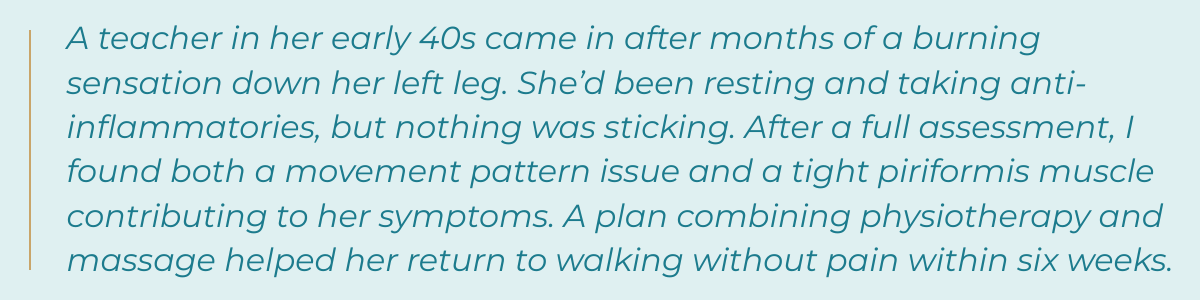
If you’ve been told to just rest and wait, I’d encourage you to come in for an assessment. Most sciatica cases improve with conservative care — and physiotherapy is a cornerstone of that approach.
3. Dizziness and Vertigo? What’s Really Going On.
If you’ve ever felt like the room is spinning when you roll over in bed or had to grab the wall after standing up, physiotherapy is evidence-informed treatment approach that can be highly effective for this.
Up to 35% of adults aged 40 and older (over 6 million Canadians) will experience a vestibular problem at some point in their lives. One in three Canadian seniors falls each year, and vestibular dysfunction is a significant contributing factor.
The most common cause of recurrent vertigo is BPPV — Benign Paroxysmal Positional Vertigo — an inner-ear condition caused by displaced calcium crystals that affect balance. Physiotherapy can help by:
→ Repositioning those inner-ear crystals using techniques like the Epley maneuver
→ Retraining your balance and vestibular system
→ Addressing neck tightness or post-concussion factors that contribute to dizziness

Clinical guidelines support vestibular rehabilitation as an effective treatment for dizziness and vertigo, with resolution rates exceeding 90% for BPPV — often in just one to three sessions.
If your dizziness has been dismissed or attributed to “nothing serious,” but you’re still living with it — please come in. There is very likely more we can do.
4. Morning Heel Pain? It Could Be Plantar Fasciitis.
You know the feeling. You get out of bed in the morning, take your first step, and a sharp, stabbing pain shoots through your heel. After a few minutes of walking it eases off but it returns after sitting for a long stretch, or toward the end of a run.
That’s plantar fasciitis. And it’s more common than most people realize.
Plantar fasciitis accounts for approximately 15% of all foot conditions seen in clinical practice and most commonly affects people between 40 and 60 years of age. Among runners, the prevalence can be as high as 22%. It affects both athletic and non-athletic populations — teachers, healthcare workers, tradespeople, parents running after toddlers — anyone spending long hours on their feet.
The plantar fascia is a thick band of connective tissue along the bottom of the foot that absorbs the load of walking, running, and standing. When it’s repeatedly stressed without adequate recovery — or when the mechanics of how you move aren’t distributing load evenly — it becomes irritated and inflamed.
What I often see is people who’ve been managing it for months with rest, stretching randomly, or new shoes that haven’t helped. Physiotherapy addresses it differently. I assess:
→ Foot and ankle mechanics — how your arch, ankle, and calf are loading
→ Hip and gluteal strength — often a contributing factor people don’t expect
→ Gait patterns — how you’re walking or running, and where the overload is coming from
→ Footwear and activity demands specific to your life
The 2023 Clinical Practice Guidelines on plantar fasciitis from the Academy of Orthopaedic Physical Therapy recommend physiotherapy interventions including targeted stretching and strengthening, manual therapy, dry needling, and gait retraining as the evidence-based approach — ahead of injections or surgery for most presentations.
If you’ve been told plantar fasciitis just takes time — that’s partially true. But the right physiotherapy approach may help support a faster recovery and reduce recurrence risk.
5. Pelvic Health: Bladder Leaks, Pelvic Pain, and Symptoms You Thought Were Normal.
This is one of the biggest “I didn’t know physiotherapy could help with that” areas I encounter — and it’s the one I’m most passionate about changing.
Pelvic floor disorders affect up to 1 in 4 women in Canada. That includes urinary leaking when you cough, sneeze, laugh, run, or jump — and it also includes urgency, pelvic pain, prolapse symptoms, and painful intercourse. Many people are still told:
→ "That’s normal after having kids."
→ "That’s just part of getting older."
It might be common. But it’s not normal or something you have to live with.
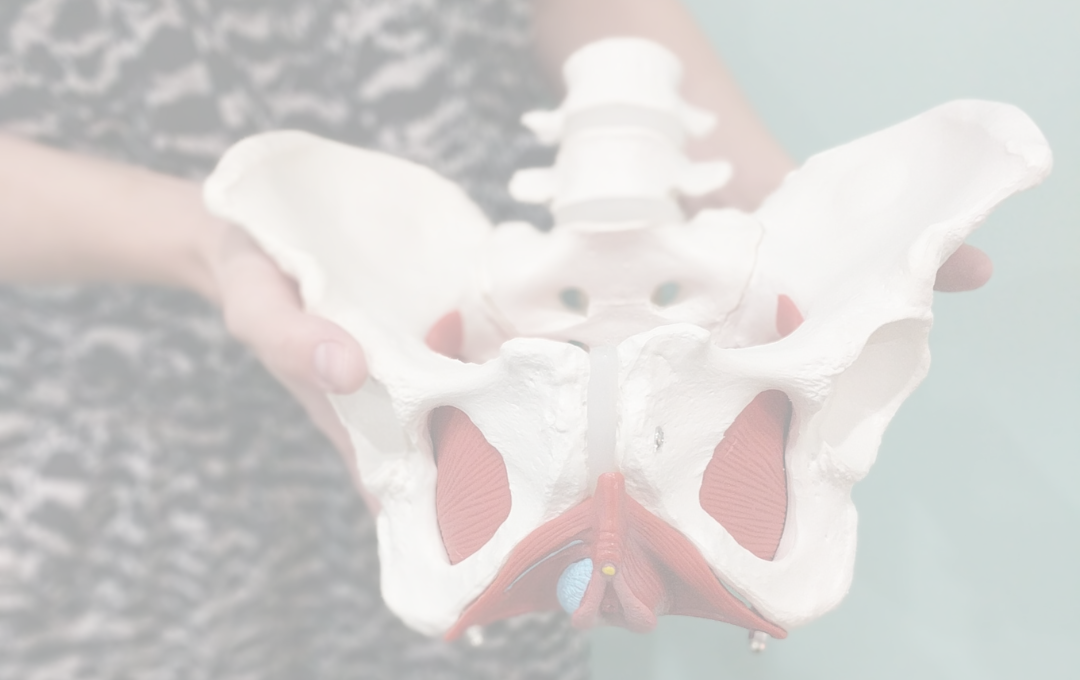
Pelvic floor physiotherapy is recommended as a first-line treatment before surgery or medication for most pelvic floor conditions. A 2024 Canadian position statement from the Canadian Society of Pelvic Medicine named pelvic health physiotherapy as an effective conservative intervention across all life stages — yet access and awareness remain significant barriers.
In my pelvic health practice, I support people through:
Bladder leaks (stress and urgency incontinence)
Pelvic pain, including pain with intercourse and chronic pelvic pain
Pregnancy and postpartum recovery — including diastasis recti, perineal healing, and scar tissue
Pelvic organ prolapse
Perimenopause and menopause changes including pelvic floor shifts and bladder urgency
Core strength and stability, including return to sport postpartum
I also want to be clear: pelvic health physiotherapy is not only for women, and it’s not only for people who’ve had children. Men experience pelvic floor dysfunction too — including after prostate surgery and with chronic pelvic pain. And pelvic floor health matters at every stage of life.
6. Headaches? Where They Might Be Coming From.
Many headaches aren’t just about your head.
They’re often connected to the neck, jaw, and how your body holds tension throughout the day.
They’re often linked to:
→ Neck tension and restricted cervical movement
→ Jaw alignment and temporomandibular joint (TMJ) dysfunction
→ Teeth clenching or grinding
→ Stress patterns that create chronic muscle bracing in the jaw and upper neck
Research published in the American Family Physician in 2023 found that among people with temporomandibular disorders, headaches were present in 79%, bruxism (teeth clenching and grinding) in 58%, and neck pain in 51%. These symptoms often appear separately — but they share a root cause, and that’s where physiotherapy comes in.
When I assess someone with suspected TMJ involvement, I’m looking at the jaw joint itself, the cervical spine, posture, and lifestyle patterns — including stress and sleep. Physiotherapy helps reduce symptoms by improving movement, restoring muscle balance, and addressing the postural drivers that keep the tension cycling. Evidence supports physiotherapy approaches for neck-related headaches and jaw dysfunction as part of a broader care plan.
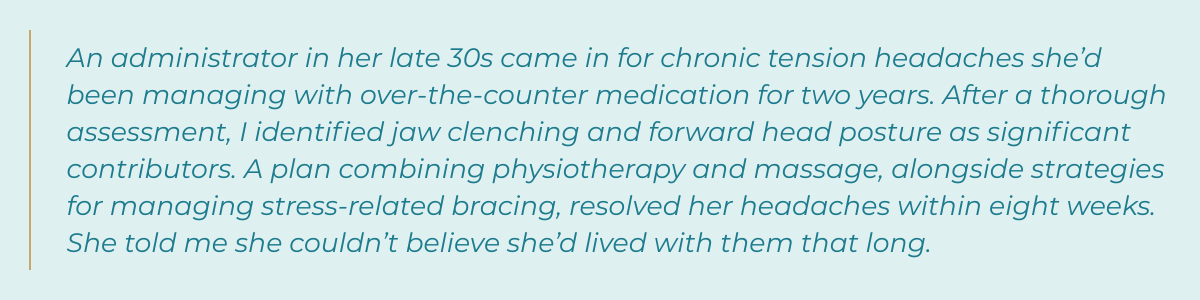
If your headaches are worse in the morning, triggered by stress or chewing, or come with jaw clicking, tightness, or ear pressure — it’s worth finding out if the TMJ is involved.
7. Concussion? It’s Not A 24 Hour Concern.
Concussion is one of the most misunderstood and under-treated conditions we see in physiotherapy, and it’s an area where specialized training really matters.
At our clinic, concussion care is primarily led by my colleague Maegan Marshall, who has advanced training in concussion rehabilitation.
You don’t need to lose consciousness to have a concussion. Symptoms can be wide-ranging from headaches, dizziness, nausea, brain fog, and neck pain, to light sensitivity, disrupted sleep, and mood changes. These symptoms can appear hours or even days after the initial injury.
Approximately 100,000 Canadians experience a brain injury each year, and while many recover within 10–14 days, 20–30% remain symptomatic much longer.
That’s where targeted rehabilitation becomes important.
Maegan often explains that concussion recovery usually involves more than just the brain itself. The neck, balance system, visual system, and autonomic nervous system are frequently involved which is why rest alone is no longer considered the best approach.
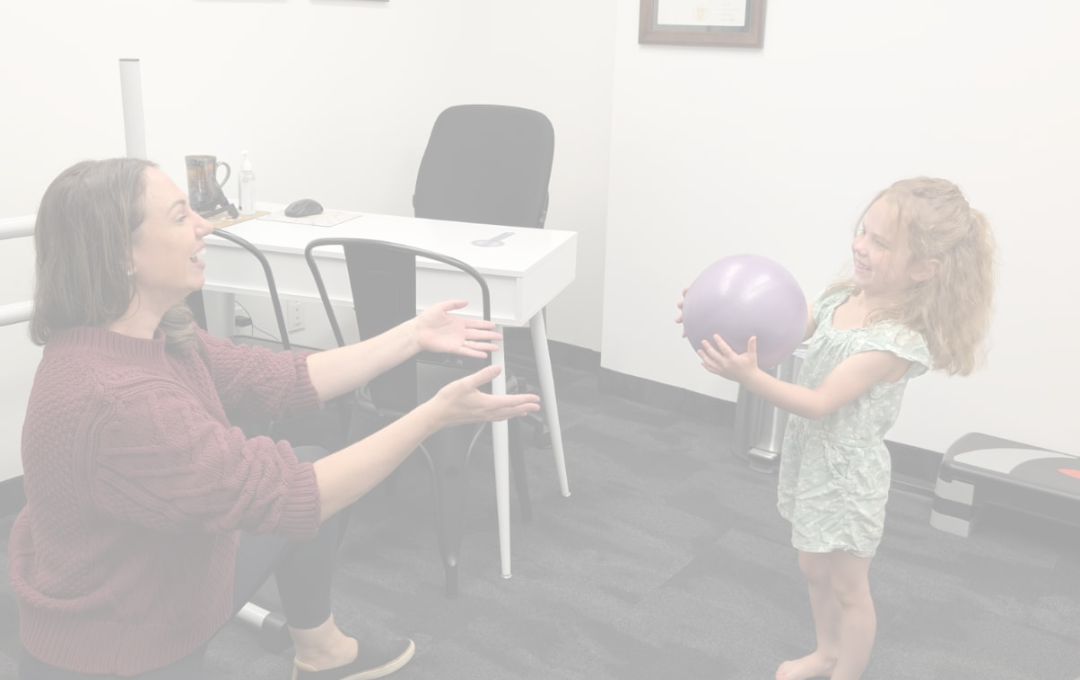
Concussion recovery often involves multiple body systems — the neck, the vestibular system, the visual system, and the autonomic nervous system. As a physiotherapist with training in concussion management, she can assess and address all of these. Prolonged rest alone is no longer the standard of care. Early, appropriate, active rehabilitation matters.
The Difference Between Treating Pain and Understanding It
At Holistic Physiotherapy & Wellness in Saskatoon, we don’t just look at one part of your body.
We look at:
→ How everything is connected
→ What led to your symptoms (not just where they live)
→ What your body actually needs to recover and stay well
I built Holistic Physiotherapy & Wellness around one core belief.
People don’t need faster care. They need more connected care.
That means taking the time to hear your full story. It means our practitioners communicating with each other about your case. It means looking at the physical, emotional, and lifestyle factors that contribute to how you feel because they are rarely separate. It also means working with you, not just treating you.
One of the things that makes our clinic different is how closely our team collaborates.
Sometimes that collaboration happens within physiotherapy. I might lead the care plan and bring in one of my colleagues for a specific treatment approach such as dry needling. Other times one of our physiotherapists begins the treatment plan and I support a specific part of the treatment while they continue guiding the exercise progression.
Collaboration often extends beyond physiotherapy as well.
For example, someone might come in with persistent neck tension and headaches. As we begin addressing movement patterns and muscle tension, it sometimes becomes clear that stress, sleep, or nervous system regulation are also part of the picture. In those situations we may coordinate care with our massage therapy team to help release chronic tension while the physiotherapy plan focuses on restoring movement and strengthening the areas that need support.
In other situations someone dealing with persistent fatigue, inflammation, or slower recovery may benefit from nutritional support alongside physiotherapy care. When appropriate we can involve our nutrition practitioner so the physical treatment and lifestyle support work together.
It is still one care plan. It is simply supported by more than one set of clinical strengths.
This collaborative approach helps patients move forward faster and feel supported the whole way through.
I was diagnosed with ADHD postpartum with my second child at 35. For years things had not quite made sense, and it took a healthcare professional truly listening to my whole story to finally move forward.
That experience is part of why I practice the way I do. I know what it feels like to be dismissed. I also know what it feels like to finally be understood.
That is what I want for everyone who walks through our doors.
What Can I Do at Home to Prevent Pain and Stiffness?
Small things done consistently make a real difference. While nothing replaces a personalized assessment, here are a few principles that support most people:
Move throughout your day — short, frequent movement breaks matter more than one long session
Focus on your breathing — diaphragmatic breathing reduces tension and helps regulate your nervous system
Stretch intentionally — targeted movement based on your specific patterns is far more effective than generic routines
Build strength gradually — especially in the glutes/hips, scapulae (shoulder blades), and core — your stabilizers.
Physiotherapy helps you figure out what your body specifically needs — so you’re not guessing, and you’re not doing the same stretches for years without progress.
Where Do You Start?
Not sure where to start? That’s okay — that’s exactly what our free discovery call is for.
You don’t need to know which practitioner to see, or have the right words for what you’re experiencing. You just need to reach out. We’ll ask a few questions, listen to what’s going on, and help you find the right fit — whether that’s physiotherapy, massage, pelvic floor physiotherapy, vestibular physiotherapy, shockwave therapy, clinical counselling, lifestyle medicine & physioyoga, dry needling, nutrition support, or somewhere else on our team.
Your body is trying to tell you something. We’re here to help you understand it.
Ready to find out if physiotherapy can help you?
Book a free discovery call with our team in downtown Saskatoon. No pressure, no obligation — just a conversation about where you’re at and how we might be able to help.
→ Book Your Free Discovery Call at holisticphysiotherapyandwellness.ca
— Kim Deschamps, MPT, BKin, PYT, BDN
Founder & Physiotherapist | Holistic Physiotherapy & Wellness | Downtown Saskatoon, Saskatchewan
holisticphysiotherapyandwellness.ca
Frequently Asked Questions
Do I need physiotherapy if I’m not injured?
Yes — physiotherapy can help with pain, stiffness, balance, prevention, and many of the conditions described in this article. You don’t need to have a specific injury to benefit from an assessment.
Do I need a referral to see a physiotherapist in Saskatchewan?
No. In Saskatchewan, physiotherapists are primary healthcare providers, so you can book directly without a physician’s referral. Some extended health benefit plans may require one for reimbursement — it’s worth checking your coverage. Our team can help you navigate this.
Is physiotherapy covered under my benefits in Canada?
Many extended health plans include physiotherapy coverage, though the amount varies. We recommend checking with your provider. We’re happy to help clarify what to ask when you call.
I’ve had this problem for years. Is it too late for physiotherapy to help?
Often, no. Chronic conditions are more complex, but that’s exactly the kind of work we’re equipped for. We look at the full picture — history, lifestyle, contributing factors — and build a plan around your specific goals. The fact that something has been present a long time doesn’t mean it’s permanent.
How do I know which practitioner to see first?
That’s what our free discovery call is for. You don’t need to figure that out on your own — we’ll listen to what’s going on and help match you with the right starting point.
Does Holistic Physiotherapy & Wellness offer virtual appointments?
We offer virtual care options within Saskatchewan for select services. Reach out to find out what’s available for your situation.
Sources and Further Reading
All statistics and clinical references have been verified at time of publication (May 2026). Please confirm links are current before citing externally.
1. Lacasse A et al. (2023). The Canadian version of the NIH minimum data set for chronic low back pain. PAIN, 164(2):325–335. https://doi.org/10.1097/j.pain.0000000000002703
2. Koc TA Jr et al. (2023). Heel Pain – Plantar Fasciitis: Revision 2023. Journal of Orthopaedic & Sports Physical Therapy, 53(12):CPG1–CPG39. https://doi.org/10.2519/jospt.2023.0303
3. South African Journal of Physiotherapy (2024). The role of the physiotherapist in concussion. PMC11079349. https://pmc.ncbi.nlm.nih.gov/articles/PMC11079349/
4. Balance & Dizziness Canada. Statistics on vestibular disorders in Canadians. https://balanceanddizziness.org/disorders/statistics/
5. Le Berre M & Dumoulin C (2024). Accessibility of Pelvic Floor Physiotherapy for Treating Urinary Incontinence in Older Women in Quebec. Physiotherapy Canada, 76(1):86–94. https://pmc.ncbi.nlm.nih.gov/articles/PMC10919363/
6. McLean L et al. (2024). CSPM Position Statement: The Landscape of Pelvic Health Physiotherapy in Canada. Journal of Obstetrics and Gynaecology Canada, 46(7):102565. https://doi.org/10.1016/j.jogc.2024.102565
7. American Family Physician (2023). Temporomandibular Disorders: Rapid Evidence Review. 107(1):52–58. https://www.aafp.org/pubs/afp/issues/2023/0100/temporomandibular-disorders.html
8. Canadian Physiotherapy Association (2024). Scope of Practice Position Paper. https://physiotherapy.ca/app/uploads/2024/04/NPM-Scope-of-Practice-Position-Paper_EN.pdf